

Oops! Something went wrong while submitting the form.

September 14, 2026


Evaluations typically focus on one primary question, whether something worked. That question matters. But on its own, it can obscure the kind of change feminist funders and movements are actually pursuing. Much of this change unfolds over years, and even decades. It comes slowly and unevenly, and one can see significant leaps forward due to the foundations built, through relationships, advocacy, community building, and long-term organizing, that traditional reporting and evaluation systems do not always capture.
Evaluating trust-based feminist funding requires looking beyond a set of expected outcomes, and asking what the funding made possible at all levels, organizationally, in relationships, leadership, governance, legal and policy frameworks, social norms and behavioral change, power, access to resources, etc. This is because often the type of funding that is distributed is flexible, unrestricted core support and not project and outcomes based. This requires a more differentiated institutional and systems change analytical lens. As a company, we love this sort of analytical challenge.
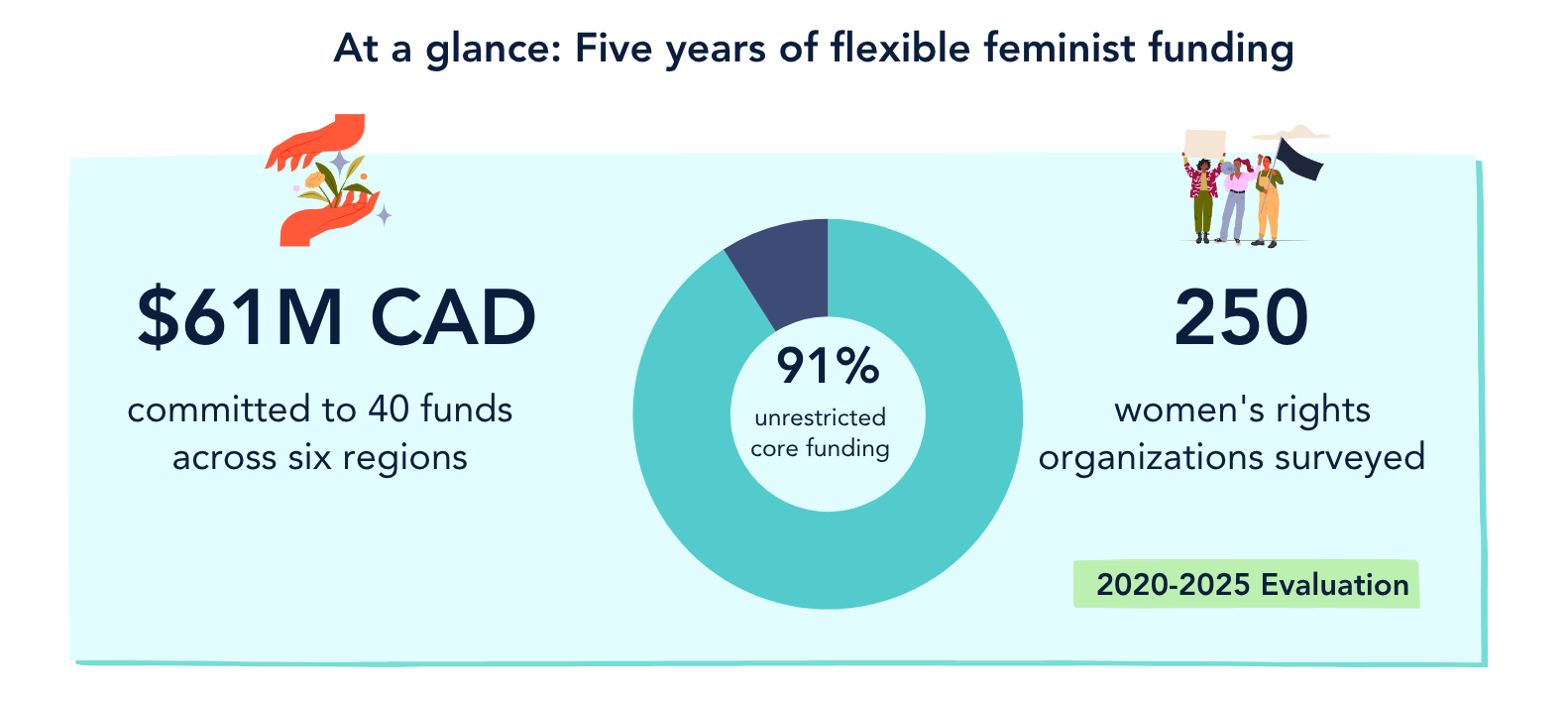
In 2025, ImpactMapper partnered with Equality Fund to evaluate five years of its investments in Women’s and Feminist Funds (WFFs). Between 2020 and 2025, Equality Fund committed roughly $61 million CAD to 40 funds across six regions, with 91 per cent delivered as unrestricted core funding. The evaluation focused on what this funding made possible during one of the toughest periods for feminist organizing in recent history, as partners faced shrinking civic space, organized backlash, and funding cuts that left many women’s funds reporting average budget reductions of 20 per cent.
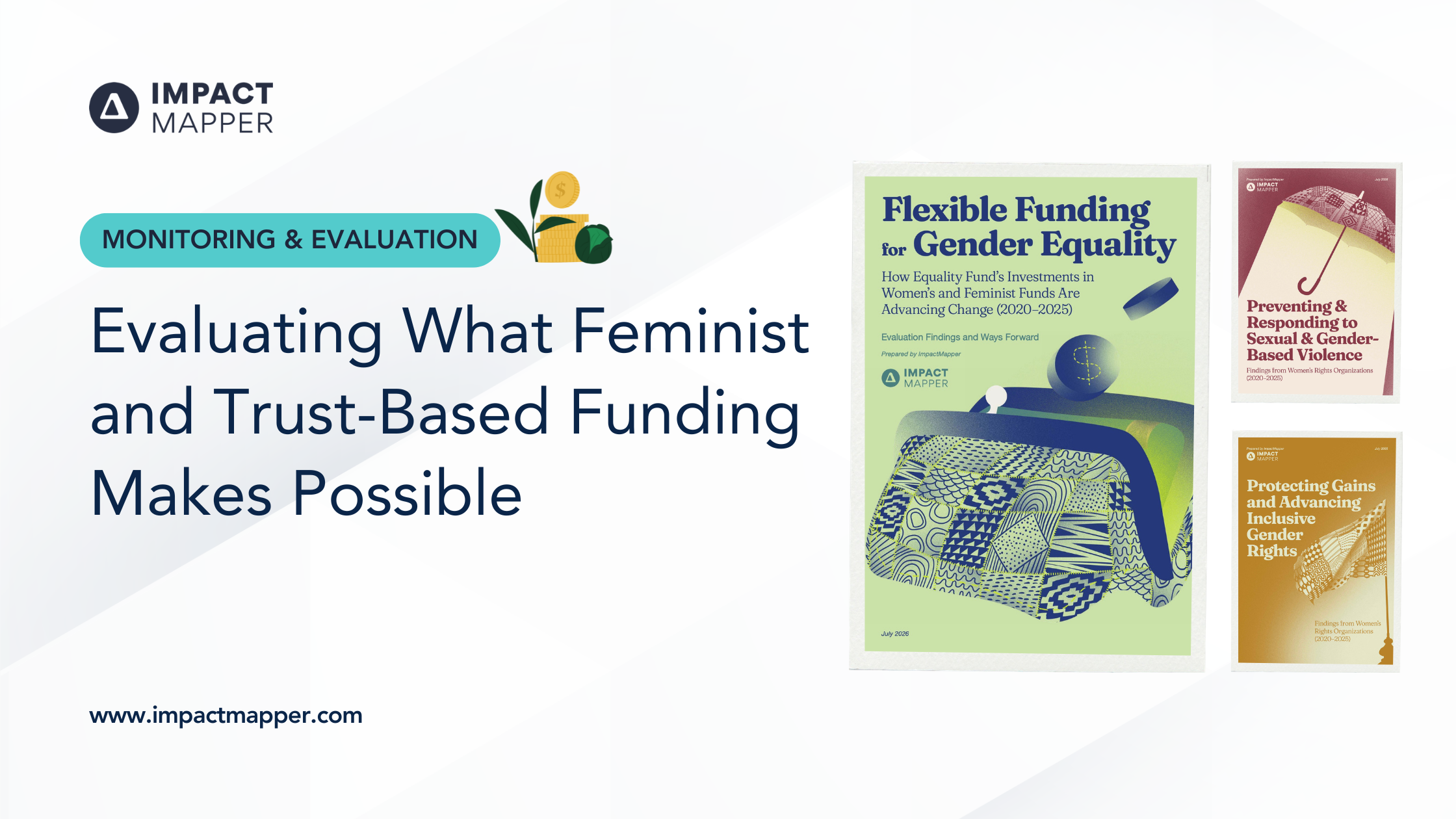
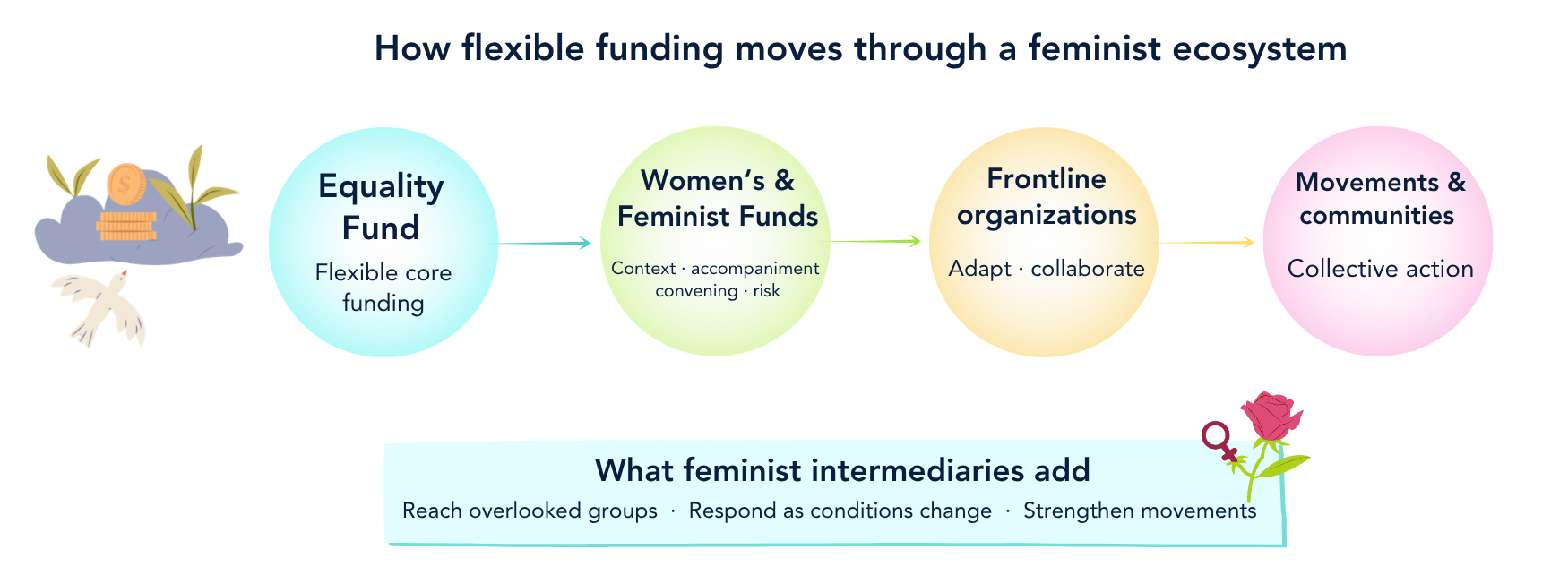
The evaluation resulted in three briefs designed to be read both separately and together. The anchor brief looks at the contributions of Women's and Feminist Funds as funders, convenors, movement actors, and sources of political accompaniment. The two thematic briefs follow what that support made possible for women's rights organizations. One covers work to protect and advance inclusive gender rights. The other covers work to prevent and respond to sexual and gender-based violence. Read together, the briefs show how trust-based feminist funding moves through an ecosystem, from the funds, to frontline organizations, to the movements and communities they support.
The evidence base combined portfolio and grant analysis, document review, a survey of 250 women’s rights organizations, interviews, and participatory sensemaking workshops with WFF partners.
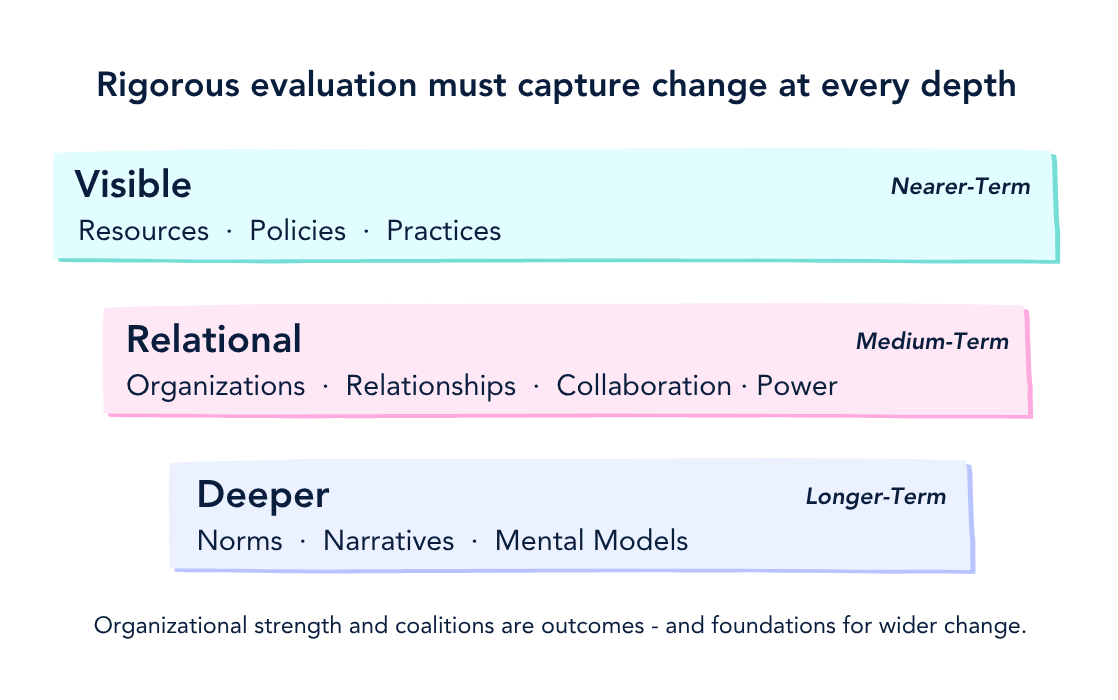
We analyzed the evidence using the Water of Systems Change framework, which looks at change across three depths, from policies and practices, to relationships and power, to the norms and mental models that are often hardest to see. This helped us look beyond visible outputs and immediate outcomes to understand how funding contributed to deeper shifts in feminist ecosystems.
Another choice shaped the evaluation as much as the framework. We treated partners as connected, rather than separate. The funds convening and accompanying movements in the anchor brief are the funders enabling frontline organizations in the thematic briefs. That is how a funding ecosystem actually works, and looking at the briefs this way shaped what we asked and what we noticed.
Partners did not simply hand us data to interpret. They helped us to make sense of it. We did this through focus groups, meaning making sessions, and direct feedback on the briefs.
Across the three briefs, one finding was consistent. Flexible, trust-based funding reached partners that mainstream donors too often miss, including unregistered groups, constituent-led organizations, those working on criminalized issues, and partners seen as too small, too political, or too risky for conventional funding.
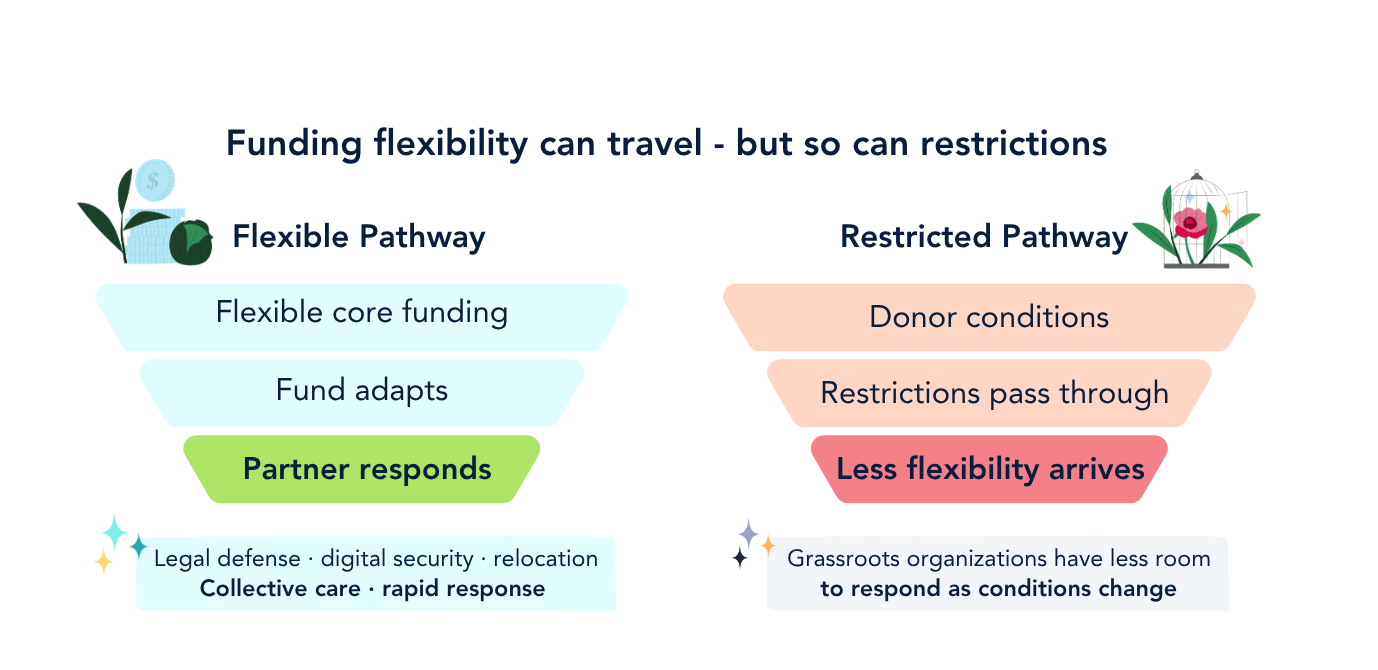
Because the funding was largely unrestricted, partners could redirect it mid-cycle and use it for needs many donors exclude, including legal defence, digital security, relocation for human rights defenders, collective care, and rapid response to political threats. In a period of backlash and shrinking civic space, this flexibility was not incidental. It was central to whether partners could keep working.
The anchor brief shows how Women's and Feminist Funds did far more than pass on resources. They convened partners, absorbed political risk, and carried the contextual knowledge frontline organizations depended on. The results were concrete. In Fiji, Women's Fund Fiji used core funding to help grantees secure land and launch economic initiatives. In Argentina, Fondo de Mujeres del Sur brought feminist legal analysis to the Inter-American Court of Human Rights, which in 2025 recognized the right to care as an autonomous human right. In Ukraine, the Ukrainian Women's Fund brought women's rights organizations into national recovery planning.
The thematic briefs show what that support enabled on the ground, and how far it travelled. In Pakistan, Da Hawwa Lur, supported by Women's Fund Asia, drafted a Transgender Protection Policy and submitted it to the provincial Standing Committee on Social Welfare and Women Empowerment. In Colombia, Asociación Nacional de Mujeres Buscando Libertad, supported by the Red Umbrella Fund, won a place in national policy discussions on the rights of sex workers, joining committees it had been excluded from. And in Argentina, partners like the Transfeminist Dissenting Butterflies defended hard-won protections and pushed institutions to be more inclusive even as civic space closed around them.
The strongest evidence appeared in strengthened organizations, better collaboration, and wider access to funding. Shifts in policy, public narrative, and formal power appeared as outcomes over the longer term and less directly, through strengthening the movements that funding helped sustain. That is not a weakness in the work. It is a more accurate picture of how deep change often happens slowly, collectively, with the contribution of many actors.
The evaluation also surfaced a key tension in the flexible funding model. The flexibility that makes this type of funding effective can be difficult to protect. Most funds rely on several donors at once, each with its own requirements. When one donor attaches strict conditions to a grant, those restrictions can move through the funding chain, even when the fund itself is trying to provide flexible support, one of the hallmarks of effective philanthropy. As a result, a small grassroots organization may receive more restricted funding than intended because of where part of that support originally came from. This tension is outlined at the fund level in the anchor brief and affects the organizations on the ground as detailed in the thematic briefs.
This evaluation did more than assess one funder’s model, although the findings were largely positive. It showed that relational, political, and long-term work can be evaluated rigorously without stripping away what makes it effective.
Doing this well requires a different set of evaluation commitments. It means taking institutional capacity building, norm change, and coalition strengthening seriously as outcomes, rather than treating them as secondary or too difficult to assess. It means working with longer time horizons that reflect how deep, structural, systems changing work often unfolds. And it requires treating partners as interpreters of their own work, not only as sources of data, from an extractive evaluation model.
For a feminist funding ecosystem facing deep cuts and rising backlash, these choices matter. They shape whether evidence can defend this funding, or whether it quietly undermines the very things that make it valuable.
Each brief stands on its own. Together, they make a fuller case that trust is not the soft edge of this funding model. It is what makes it work. For funders and feminist movements, they show why flexibility and trust matter in practice, and what becomes possible when resources move through actors embedded in movements. For evaluators, they offer a way to hold onto rigour without reducing complex, political, relational change to a handful of short-term indicators.